Elinora St. Clair
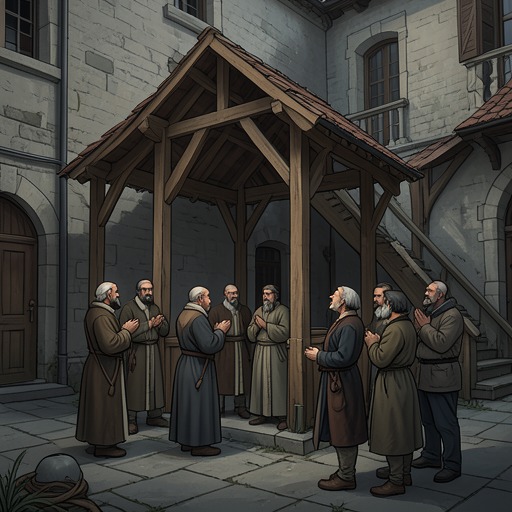
The StaircaseElinora St. Clair is Bishop Jean Baptiste Lamy’s grandniece and Lizzy Enders’s childhood rival, first encountered on the Santa Fe Trail and later at the girls’ school in Santa Fe. Her story moves between privilege and vulnerability, self-assertion and dependence: she is accustomed to having her wishes accommodated, yet she also seeks counsel about her future and turns to her uncle when she needs protection. Through her, the novel makes rivalry more complicated than simple antagonism; she is one of the people whom Lizzy eventually comes to count among life’s human miracles.
Identity and Background
Elinora travels with Lizzy and Lizzy’s family because Bishop Jean Baptiste Lamy has asked Lizzy’s father to bring his grandniece to the girls’ school in Santa Fe. He offers to pay for Elinora’s safe delivery, allowing Lizzy’s father to avoid taking money from Mama’s brothers. The caravan carries supplies for the school as well as its passengers, and the journey is not merely a family trip: it is also part of the Bishop’s plan for Elinora to experience travel on the Santa Fe Trail before railroads take over.
During the journey, Elinora’s family connection gives her a conspicuously favored position. If she wants to stop for wildflowers, the party stops; she has her own basin of water even when Lizzy and Mama share one while crossing dry country. At Fort Union, Mama is already ill, but the party still takes Elinora through the fort to see it. Lizzy’s saddle pony, Ben, becomes another point of friction: Elinora cries when Lizzy rides him, so Lizzy must either sit in the wagon with her or let her ride. After Elinora falls and nearly injures herself, Mama forbids her to ride again. These incidents establish both the indulgence surrounding Elinora and the everyday compromises expected of Lizzy.
The Journey and Its Early Rivalry
Elinora’s first response to Lizzy’s mother’s burial exposes how sharply their temperaments differ. As Lizzy’s father digs the grave with one arm, Elinora suggests hanging the body between tree branches to keep wolves away and offers the possibility of bringing her on for a proper burial. Lizzy rebukes her and insists that her mother will not be left hanging in a tree. Elinora’s suggestion is practical in its own stark way, but Lizzy experiences it as an affront at a moment of grief. The exchange fixes an early pattern: Elinora speaks without softening her words, while Lizzy resists both her tone and the privileged confidence with which she voices them.
Later, when Lizzy wakes to discover that the caravan is leaving, she demands to know why Elinora did not tell her. Elinora says she did not know; Lizzy calls her a liar. The scene records the depth of Lizzy’s suspicion but does not settle whether Elinora knowingly withheld the news. That uncertainty matters: their rivalry is filtered through Lizzy’s hurt and mistrust, and the accusation itself cannot be treated as proof that Elinora deliberately deceived her.
Life at the School and Claims of a Calling
At the academy, Elinora presents a more searching concern than her earlier quarrels might suggest. During a visit to seek advice from Doña Elenita, she first hands over a small basket of food intended as an offering, then turns to the reason for the visit. She says she believes she has a calling to become a nun and asks whether that calling is real. The scene shows her actively seeking guidance about a possible future, but it does not resolve whether her conviction is lasting or sincere. Her question is presented as a request for discernment, not as a decision already made.
Elinora’s relationship with the school’s authority becomes especially visible when Bishop Jean Baptiste Lamy returns. She runs to him, kneels at his feet, and apologizes for having been naughty. In front of the gathered nuns, students, household workers, and passersby, she says that Lizzy wanted to sneak out and that she accompanied her only because she feared for Lizzy’s safety. Lizzy immediately recognizes this account as a lie and as an act of performance. The Bishop embraces Elinora, while Mother Magdalena takes Lizzy away and holds her responsible for the trouble. Elinora’s explanation thus has a public consequence: it wins her the Bishop’s welcome and redirects the school’s blame toward Lizzy.
The contrast between this episode and Elinora’s request for spiritual advice resists an easy judgment of her. She can speak earnestly about a religious vocation and also shape a public story to her advantage. The novel leaves those details beside one another rather than making the claim of a calling a guarantee of virtue.
Relationships and Conflicts
Lizzy and Elinora’s relationship is shaped by proximity as much as by temperament. They travel together because the Bishop’s request places them in the same caravan, and Lizzy repeatedly has to accommodate Elinora’s jealousy, tears, and favored status. Their arguments, however, do not erase their connection. At the convent, Elinora is present within Lizzy’s social world, and her decisions can affect how others judge Lizzy, as the Bishop’s return makes plain.
Elinora is also tied to the school through her uncle’s authority. The arrangement that brought her to Santa Fe begins as a family obligation supported by the Bishop’s resources; later, his arrival offers her a direct route back into his favor. Her kneeling apology makes that family bond public, while the surrounding crowd turns a private reunion into a scene in which Lizzy is left exposed. The relationship therefore carries both affection and power: the Bishop welcomes Elinora, and his standing helps determine how the school interprets the girls’ conduct.
When Lizzy asks the Bishop to give work to a hungry carpenter who has been put in the barn, she acknowledges that Elinora is a reason for hesitation, then leaves the matter unstated. The Bishop nevertheless agrees to let the carpenter inspect the chapel staircase. The passage offers only a glimpse of Elinora’s position on the proposal; it does not specify her objection. It does, however, show that her preferences remain part of the social calculation around the school, even when Lizzy is trying to secure help for someone else.
Change and Narrative Significance
The staircase episode places Elinora within a larger conflict over belief, without making her the narrator of its resolution. After the carpenter completes the staircase and disappears, Mother Magdalena declares that he was Saint Joseph, and the nuns kneel to pray. Lizzy rejects that explanation, remembering the carpenter as a poor, wounded man who had spoken with her and held her kitten. The opposing responses keep the supernatural claim open rather than proving it through the characters’ reactions.
In the author’s account of the novel, Elinora nonetheless occupies an important place in Lizzy’s eventual sense of miracles: the examples are people, including Bishop Jean Baptiste Lamy, Sister Roberta, and, at the end, Elinora. This framing makes Elinora significant not because the story confirms a supernatural identity for her, but because Lizzy’s understanding of goodness and possibility includes human beings. The author describes Lizzy as leaving the convent a better person, though still unsure whether she has met Saint Joseph. Elinora’s place in that change marks a movement beyond the child who could only see her as a rival, without requiring the novel to erase their earlier conflicts or explain every step of their reconciliation.